Quick Answer: Money follows a three-stage arc. Early game you are the economy — serve guests yourself and live on tips. Mid game, reservations take over as the better income. Late game, bank projects are where the gold goes. Two genuine passive trickles sit on top: the market stall, which pays out automatically, and bank interest, fixed and player-confirmed as of July 24. One hard design truth governs everything: taverns you are not standing in earn very little, on purpose. This page maps every income source, the stage it matters at, and what is currently broken.
Version note: Written at V1.0.5 (July 23, 2026) and updated through V1.0.9 and the developer's August 4 answer on transferred level points. Sources are CROWFORGE Games' Steam forum replies (May–July 2026), the official 1.0 through V1.0.9 patch notes, and Steam global achievement percentages captured July 20, 2026. Single-player reports are flagged where used.
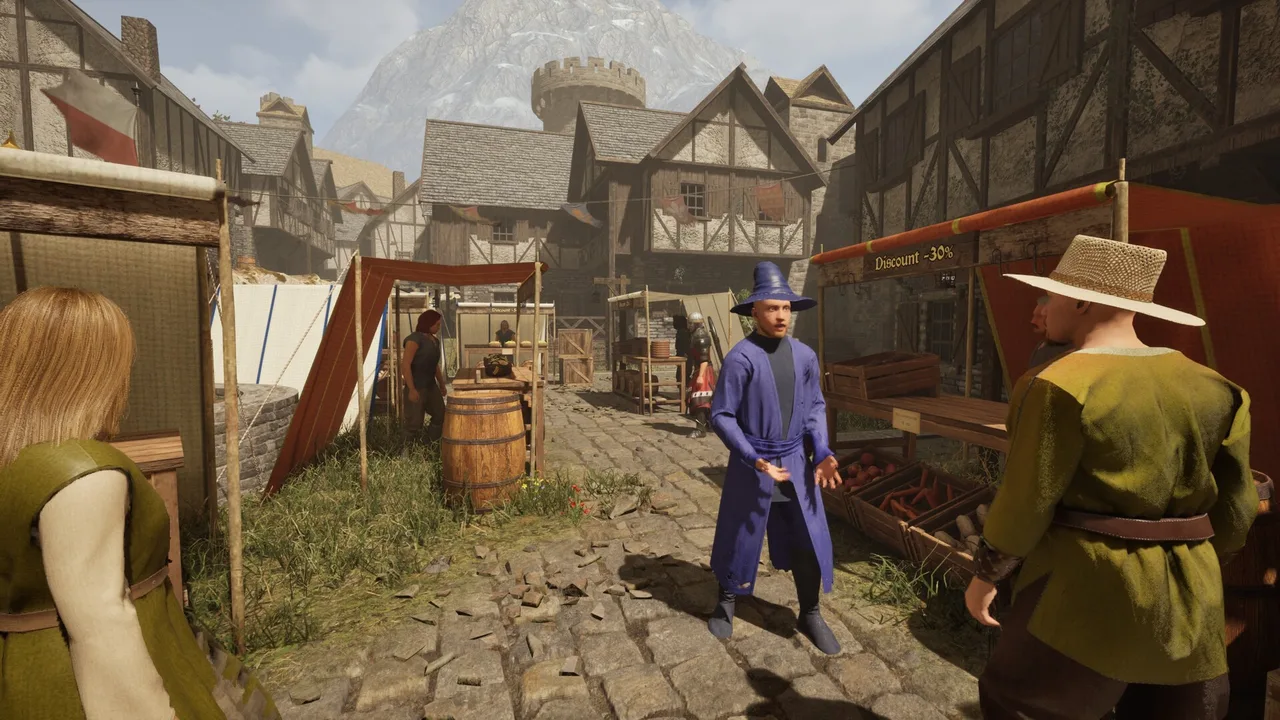 The town market: where you buy ingredients — and, once you own a stall, where one of the game's two real passive incomes lives. (Screenshot: CROWFORGE Games)
Every Income Source in the Game
| Source | When it matters | Status |
|---|---|---|
| Tips from fast personal service | Early game — this is the early economy | Working |
| Order revenue (and raising your prices) | All game | Working |
| Reservations (group bookings, weddings) | Mid game onward — "more valuable later" per the developer | Working |
| Market stall profits | Passive, once purchased | Working (player-reported payouts) |
| Bank interest on deposits | Passive | Fixed July 24 — developer: "Should be solved now!"; two players confirm interest arriving |
| Quests from townsfolk | Situational | Working |
| The golden mug | It drops money. That's the feature. | Working as intended, per the developer |
| Moon Juice (tip multiplier) | Mid/late, after tavern level 3 | Working — with a catch |
The Economy Arc: Early, Mid, Late
The developer laid the money design out directly, and 1.0 behaves the way it describes:
- Early: "You start small, serve guests yourself, pour beer, clean, earn gold." And from a launch-week reply: "tips are especially important early on, while reservations become more valuable later. I recommend serving guests yourself at the beginning." Wages are a real cost against thin early margins, and you are cheaper and faster than any worker. The Beginner Guide covers this stage in detail.
- Mid: more guest classes arrive, reservations become the structured higher-value income, and you buy a bigger tavern. Read the level-points rule below before you do.
- Late: "With your owned money you can invest into projects at the bank which allows you to unlock more areas in the city, more bigger taverns and even brew your own beer later on."
The developer's own summary of the levers available: "passive income from the market and bank, make quests or increase the prices for your orders." That list is the checklist for the rest of this page.
Why Absent Taverns Earn Almost Nothing (By Design)
The most-asked money question on the forums — "I own three taverns, why am I only making ~400 gold a day?" — has an official answer:
"Currently, you earn significantly less money when you are not present in the tavern. It is recommended to open only one tavern at a time."
And on the point of owning several at all:
"The goal and idea is not supposed to be passive income from multiple taverns running in the background. The focus should be on actively managing your tavern and simulating a barkeeper."
V1.0.9 (July 28) softened the rule without repealing it. An option now allows multiple taverns to operate at the same time, with the notes' own warning that it "could cause performance issues," and workers can be switched between taverns. Plan around three consequences:
- Don't buy taverns expecting an idle-game curve. The absent-tavern income penalty is untouched. Running several bars at once means more open bars, not more idle income. Extra taverns are bigger, differently-themed playgrounds — one player runs a knights-only tavern and a mages-only tavern with different menus and prices, which is the intended spirit.
- Stagger your opening days so you are always working the one that is open. Or open them simultaneously since V1.0.9 if your hardware tolerates it, and watch your FPS while you test: performance in a single full tavern is already the game's top complaint.
- Staff per tavern, not in total. The cap is 4 workers per tavern, and since V1.0.9 you can move trained workers between them instead of hiring fresh. A staffed tavern you are absent from still underperforms the one you are standing in.
The Market Stall: Passive Income That Works
Buy a market stall and it periodically notifies you that it made a profit, crediting the gold automatically. There is no management loop attached. (Payout behavior comes from a German-language forum report, July 20; the developer's replies in the same thread treat it as normal.)
Against the low bar of "money while you sleep," the stall is the reliable option.
The Bank: Interest Works Again (Fixed July 24), Projects Are the Point
Interest: deposited gold earns daily interest at the rate the bank displays, credited at midnight. Do the math before you commit a pile of gold to it: at the 2% rate one player saw, a 2,000-gold deposit works out to about 40 a day. Payouts stopped working through launch week — one player parked 2,000 and another 5,000 for days with nothing arriving, and a July 21 adjustment did not help — but two players independently confirmed interest arriving again on July 24, and the developer posted "Should be solved now!" the same day. Update to the latest version and parking gold in the bank is a real passive trickle again. The gold price freeze reported alongside it is closed out as fixed too: the original reporter confirmed on July 29, and no fresh reports have appeared since. History is on the Bugs & Fixes page.
Projects: the bank's real role is the late-game money sink. Construction projects unlock new city areas — including the "Lower District" behind the black wall next to the cheapest tavern, which is locked content rather than a bug — plus bigger taverns and eventually brewing your own beer (5.5% of players have gotten there). When you wonder what all the gold is for, it is this.
Raising Prices, Quests, and the Golden Mug
- Prices are adjustable per order item, and the developer lists raising them among the legitimate money levers. There is no community consensus on how far you can push before guests react, so treat it as a dial to experiment with rather than a documented curve.
- Quests from townsfolk pay gold and arrive through NPC dialogue. That is one reason the reported missing-subtitles bug matters more than it sounds.
- The golden mug drops money and blasts holy music. That is intended: "the golden mug should drop money — that [is] not [a] bug." Since V1.0.5 the holy sound effect has its own volume slider.
- Moon Juice, unlocked at tavern level 3, makes guests "especially happy and tip generously — but also considerably more aggressive." It is a tips multiplier priced in chaos.
Selling Up: the Tavern Level Catch
Learn this rule before you outgrow your first tavern:
"You can sell your current tavern and spend tavern level points into the new one, otherwise you have to start with level 1 again."
Sell the old tavern to transfer its level progress. Keep it and your new tavern starts from level 1. If your goal is one great tavern rather than a collection, selling up is the intended and cheaper route. The collector's route exists too — owning every tavern in town is an achievement at 2.5% of players.
Apply the transferred points on the purchase sheet itself. When you buy the new tavern, arrows on that sheet let you set its starting level, and that is where the points get spent. If you sold your old tavern and the new one still says level 1, look for those arrows on the purchase screen rather than in a menu afterwards.
Milestones: Are You On Pace?
Steam global achievement stats, captured July 20, 2026:
| Milestone | Players who reached it |
|---|---|
| 5,000 gold earned | 31% |
| 10,000 gold earned | 13% |
| Second tavern purchased ("Double Tap") | 16.7% |
| Brewing own beer | 5.5% |
| Own every tavern in town | 2.5% |
A few thousand gold in your first hours is normal pace. If you are far behind, the usual culprits are hiring staff too early and waiting on passive income the design deliberately keeps small.
FAQ
What's the single best money habit early on? Serve fast, yourself. Tips scale with service speed, and wages are a cost you do not need yet. The full early-game routine is in the Beginner Guide.
Is there any real AFK/idle income? The market stall and bank interest, working again since July 24. Both are trickles. The game's answer to "can I automate the money?" is deliberately no, and even a fully staffed tavern earns significantly less without you in it.
Should I gamble at the Golden Chicken casino? Treat it as a gold sink, not an income source. The 1.0 questline exists and roulette is playable, but there is no community documentation on whether the odds make it viable. Two signals point away from it: V1.0.9 added a bet limit, and the developer said he will look at securing the casino against save-reload abuse, calling it "the player's responsibility" not to exploit an optional system into ruining your own progression.
Do workers pay for themselves? Eventually, but each worker handles exactly one order at a time, so their revenue ceiling is real. Hire when guest volume outruns you, and configure them properly or they earn nothing at all: Workers Guide.